
Presentation of the Alternative Dispute Resolution Code
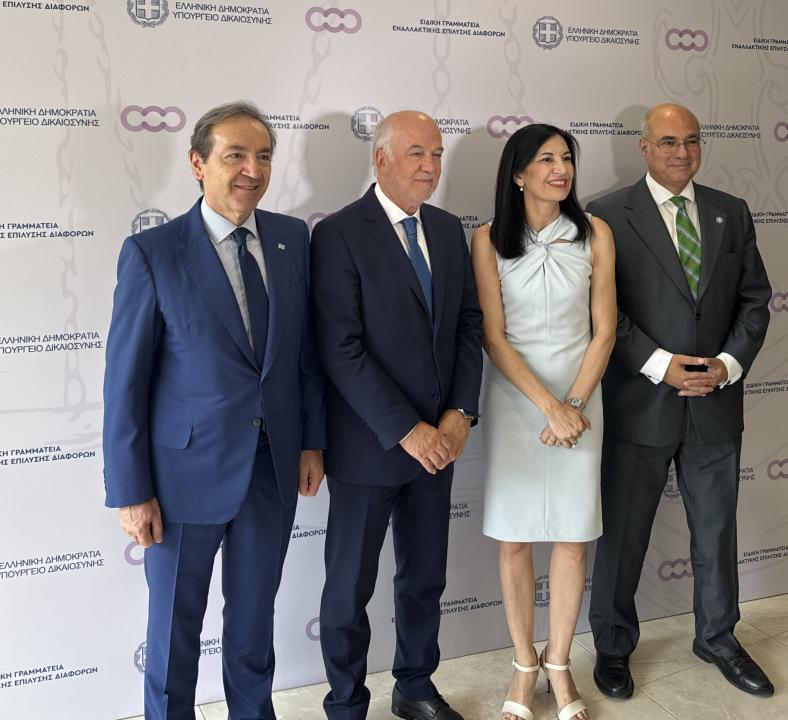
The new Alternative Dispute Resolution Code (ADR Code) was presented today at a special event held at the Ministry of Justice in the presence of the Minister of Justice, Georgios Floridis, and the Deputy Minister of Justice, Ioannis Bougas, by the Special Secretary for Alternative Dispute Resolution, Olympia Anastasopoulou.
The drafting of the ADR Code constitutes a landmark reform initiative that goes far beyond a mere codification exercise. It represents the first comprehensive and systematic consolidation of the three principal methods of alternative dispute resolution within the Greek legal system: Arbitration, Mediation and Judicial Mediation.
The ADR Code aims to establish a modern, coherent and reliable framework for alternative dispute resolution that will strengthen the confidence of citizens and businesses, facilitate the effective administration of justice, and further align Greek law with international best practices.
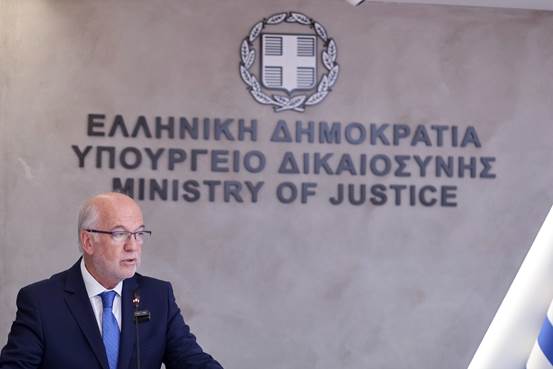
The Minister of Justice, Georgios Floridis, stated:
“One of the first initiatives we undertook together with Deputy Minister Mr. Bougas upon assuming office at the Ministry of Justice was the development of a comprehensive framework for alternative dispute resolution. We firmly believe that this initiative can make a significant contribution to improving the efficiency of the Greek justice system while, at the same time, fostering a culture in which citizens are encouraged to resolve their disputes amicably rather than resorting to ordinary court proceedings.
Our objective was to develop an Alternative Dispute Resolution Code by bringing together into a single legislative instrument all the provisions that had previously been scattered across different pieces of legislation, thereby equipping Greece with one of the most modern legislative frameworks in this field within Europe.
Experience from other European Union countries shows that the results have been encouraging in some cases, but not in others. The assessment of the political authorities in those countries is that one of the reasons why the institution has not flourished is that it has not been embraced by the legal profession. Whether this reluctance is justified or not is immaterial. This experience, together with the Greek experience of the operation of the institution, led us to take decisions aimed at facilitating the work of its key participants.
The success of this institution will depend primarily on the extent to which it is supported by the legal profession. With the new Code, we have sought to provide the legal profession with incentives to actively support it. As the institution continues to evolve, it will further facilitate the transfer of cases from the courts, creating greater opportunities for the legal profession as well as for economic stakeholders.
Germany’s experience shows that when companies, traders or members of chambers of commerce have disputes among themselves, the chambers regard it as a significant failure of their institutional mission if those disputes end up before the courts instead of being resolved through this institution within the chamber. This is what we seek to achieve in Greece as well. For this reason, alongside the legal profession, economic stakeholders must also become key participants, and we engaged extensively with them throughout the preparation of the new Code. We hope that the Alternative Dispute Resolution Code will eventually be taught in law schools, alongside Civil Law and Criminal Law, because it is important for future lawyers and young legal professionals to be educated in this new approach from the very beginning.
This has been the prevailing perception for decades: lawyers are trained to fight and to confront one another. Today, however, law schools -and subsequently the Bar Associations responsible for their professional training- must educate lawyers who appreciate the value of dialogue and mutual understanding. This represents an entirely different culture. Instead of being trained solely as adversarial advocates, lawyers should also become conciliatory mediators who guide parties towards the peaceful resolution of disputes -more quickly, more effectively and, certainly, more cost-efficiently”.
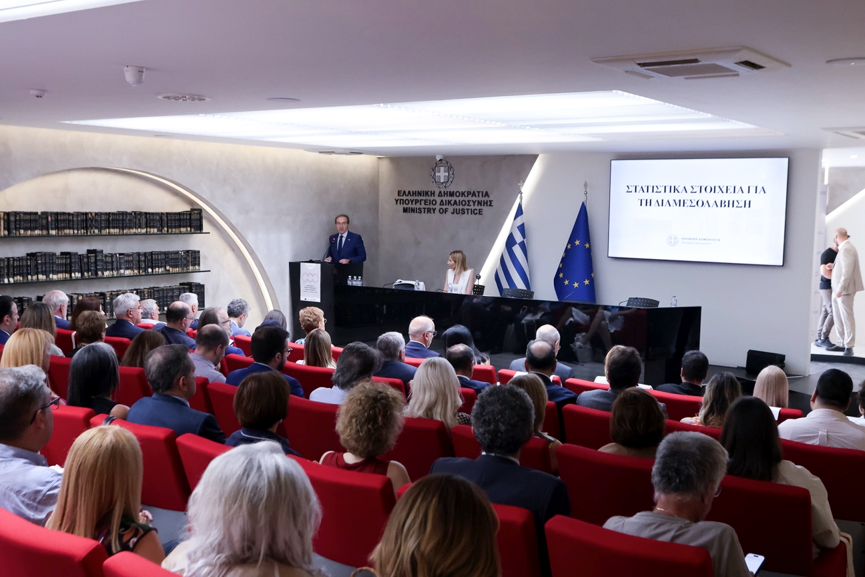
The Deputy Minister of Justice, Ioannis Bougas, stated:
“For the first time, a unified Alternative Dispute Resolution Code is being introduced. This is not merely a compilation of scattered legislative provisions, but a comprehensive reform of the existing framework, bringing together in a single, coherent legislative instrument all the principal forms of alternative dispute resolution. It introduces common principles, addresses shortcomings identified through the application of the previous framework, and establishes a modern and effective institutional environment.
The value of this codification is manifold.
First, it strengthens legal certainty. Second, it simplifies the application of the law for judges, lawyers, mediators, arbitrators and citizens alike. Third, it establishes clear and consistent rules. Fourth, it further aligns the Greek institutional framework with contemporary international developments and European best practices.
We also aspire for Alternative Dispute Resolution to be taught in law schools and to become part of the professional training and qualifying examinations for lawyers. At this point, allow me to outline the main features of each alternative dispute resolution mechanism by briefly referring to the development of each of the principal methods of dispute resolution to date.
Arbitration has traditionally been regarded as a means of dispute resolution that is not readily accessible to a broad range of disputing parties because of its high costs. In the field of arbitration, the Code substantially modernises the existing framework. It establishes a unified set of rules governing both domestic and international arbitration, introduces modern provisions that meet the requirements of international commerce, and creates the conditions for Greece to become an even more attractive venue for international arbitration.
Mediation has been an established institution since 2010. Considerable resources have been invested over the years, yet the results have not been commensurate with that investment. In the field of mediation, the Code introduces an even more far-reaching reform. Mediation is broadened in scope, organised more effectively and equipped with new tools that strengthen its practical operation. The new Initial Mediation Session is no longer confined to informing the parties but is designed to explore genuine prospects for reaching an agreement.
The essence of this reform lies not only in its individual provisions, but above all in the overall change of philosophy that it introduces. The effectiveness of a justice system should not be measured solely by the number of judicial decisions it produces. It should also be measured by the number of disputes that are resolved in a timely and fair manner, in a way that preserves relationships, reduces economic costs and strengthens social cohesion. This is why alternative dispute resolution has become an integral component of a modern justice system throughout the world.”

The Special Secretary for Alternative Dispute Resolution, Olympia Anastasopoulou, presented the new Alternative Dispute Resolution Code, emphasising that:
“The Code constitutes the first comprehensive and systematic consolidation of the principal methods of alternative dispute resolution within the Greek legal system. It brings together and modernises provisions that were previously dispersed across different legislative instruments, establishes a unified framework of general principles and common terminology, and systematically regulates the relationship between arbitration, mediation and judicial mediation. It introduces a modern framework for arbitration in line with international standards, establishes new mechanisms in the field of mediation, including the mediator’s settlement proposal and the Unified Digital Mediation Portal, and comprehensively reforms the institution of judicial mediation through the creation of a complete and autonomous legislative framework.”
The Special Secretary also highlighted the initiatives undertaken to strengthen mediation and the other methods of alternative dispute resolution at both the institutional and organisational levels, improve the services provided to citizens and legal professionals, develop partnerships with national and international organisations, and promote outreach and educational policies, with particular emphasis on school and university mediation.
Referring to the legislative initiatives of the Special Secretariat, she highlighted Law 5197/2025 (OGG A' 76), which introduced mandatory judicial training in alternative dispute resolution, as well as the possibility of cadastral mediation in cases involving municipalities, public law legal entities and the Greek State as defendants -measures that are already producing positive results. She also referred to the issuance of the Presidential Decree establishing Permanent Arbitration Centres within Chambers of Commerce.
Finally, she referred to the Policy Paper on mediation prepared by the Special Secretariat, as well as to the new website, adr.gov.gr, which was developed to provide a single, reliable and user-friendly source of information on all its actions and initiatives in the field of Alternative Dispute Resolution.
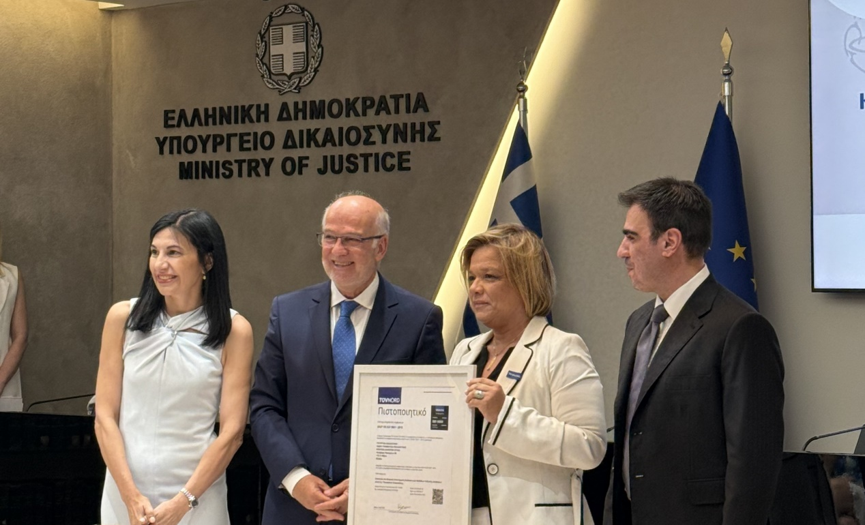
The event concluded with the awarding of the ELOT EN ISO 9001:2015 certification to the Special Secretariat for Alternative Dispute Resolution. The certification covers the scope of “Monitoring and Institutional Strengthening of Alternative Dispute Resolution Mechanisms within the Ministry of Justice” and confirms the Special Secretariat’s commitment to delivering high-quality services, ensuring transparency, pursuing continuous improvement, and providing effective services to citizens and stakeholders.
In her closing remarks, the Special Secretary underlined that:
“It is a great honour for the Ministry of Justice that the Special Secretariat for Alternative Dispute Resolution is the first Special Secretariat of the Greek Government to receive this certification. We hope that this achievement will establish an institutional benchmark for the Greek Public Administration.”